In the previous chapter, Request Parameters and Validation, we set up a strict "Customs Officer" to validate incoming data.
But here is the problem: How do visitors know what rules the Customs Officer is enforcing?
If a developer tries to use your API, they don't want to guess. They need a manual. Historically, developers wrote documentation manually in Word documents or Wikis. But the moment you changed a line of code, that documentation became outdated.
FastAPI solves this with OpenAPI Schema Generation.
Imagine an architect building a complex maze. If they draw a map on paper before they start building, and then change the layout of the walls during construction, the map becomes useless. Visitors will get lost.
FastAPI acts like a magical architect. As you place a "wall" (write code) or a "door" (define a route), FastAPI simultaneously draws a perfect, up-to-date map.
This map is called the OpenAPI Schema.
Because FastAPI generates this schema automatically from your code, your documentation is never out of date.
Let's see this in action immediately. We don't even need to write new code—FastAPI does this by default.
We will use a simple app similar to what we built in Chapter 1 and 2.
from fastapi import FastAPI
from pydantic import BaseModel

app = FastAPI()

class Item(BaseModel):
    name: str
    price: float

@app.post("/items/")
async def create_item(item: Item):
    return item
Run your server (usually uvicorn main:app --reload).
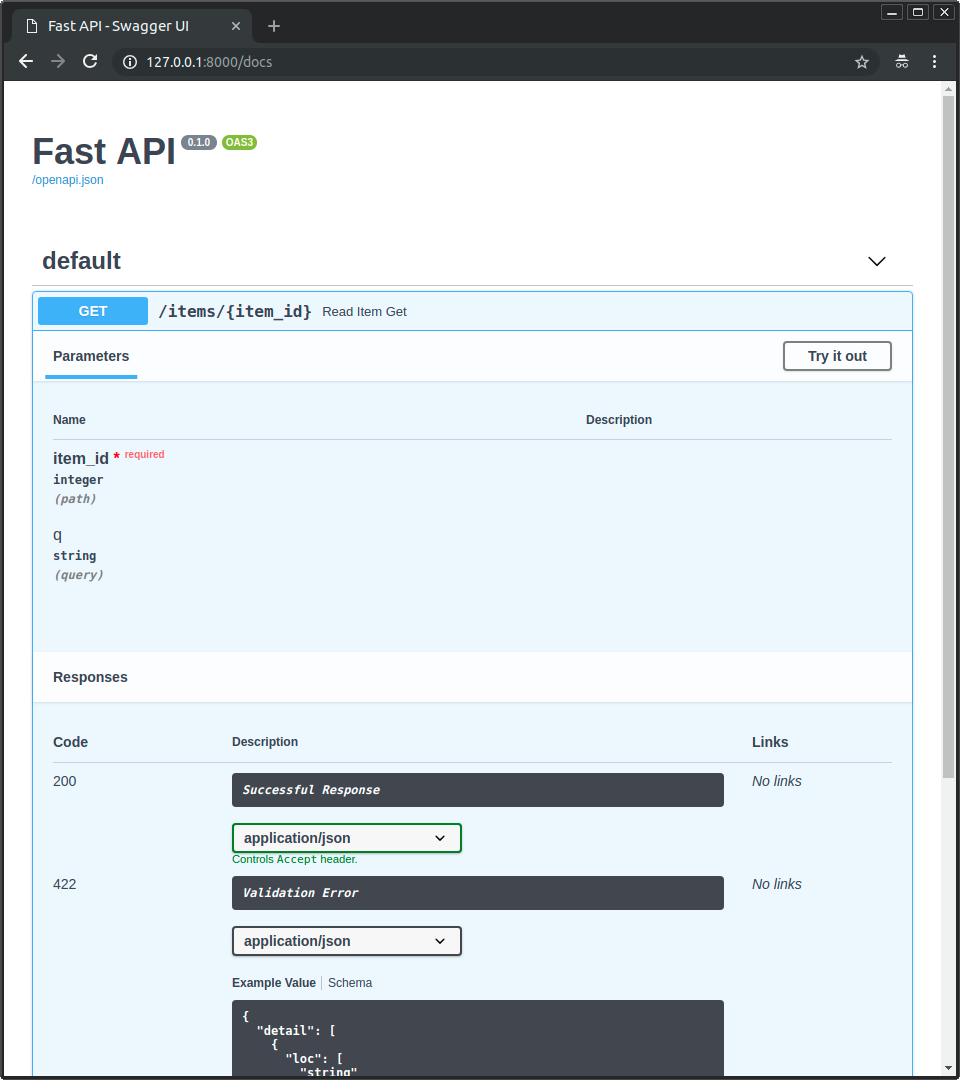
Open your web browser and go to: http://127.0.0.1:8000/docs.
You will see an interactive website called Swagger UI.
!Swagger UI Example (Conceptual visualization of the UI)
What just happened?
POST route at /items/.Item model.price is a float and name is a string.You can add details to this map to make it friendlier for humans.
When creating the The FastAPI App Instance, you can give your API a name and description.
app = FastAPI(
    title="Bakery API",
    description="An API to manage cakes and cookies.",
    version="2.5.0"
)
Explanation:
This text will appear at the very top of the /docs page, telling users what your API is for.
FastAPI reads your Python Docstrings (comments inside functions) and adds them to the documentation.
@app.get("/items/{item_id}")
async def read_item(item_id: int):
    """
    Retrieve a specific item by its ID.

    - **item_id**: The unique identifier of the item.
    """
    return {"item_id": item_id}
Explanation:
When a user clicks on the /items/{item_id} row in the documentation, they will read your description ("Retrieve a specific item...").
How does FastAPI turn Python code into a website? It uses a standard called OpenAPI (formerly known as Swagger).
Imagine a small robot inside your computer. When you start your app, this robot runs through your code once.
@app.get and @app.post.The web browser uses a tool (Swagger UI) to turn that JSON into the pretty blue-and-green website.
get_openapi Function
Deep inside FastAPI, there is a utility function that performs this "Scan". It resides in fastapi/openapi/utils.py.
Here is a simplified version of what that logic looks like.
# Simplified concept from fastapi/openapi/utils.py

def get_openapi(routes):
    # This dictionary will hold the final schema
    output = {"paths": {}}

    for route in routes:
        # 1. Get the path, e.g., "/items/"
        path = route.path

        # 2. Get the method, e.g., "GET" or "POST"
        method = route.methods[0].lower()

        # 3. Add to the output dictionary
        output["paths"][path] = {
            method: {
                "summary": route.name,
                "parameters": []
                # ... extracts params and models here ...
            }
        }

    return output
Explanation:
routes registered in your The FastAPI App Instance.You can actually see this "raw map" generated by the function above.
If your app is running at localhost:8000, visit: http://127.0.0.1:8000/openapi.json.
You will see a raw text result like this:
{
  "openapi": "3.1.0",
  "info": {
    "title": "Bakery API",
    "version": "2.5.0"
  },
  "paths": {
    "/items/": { ... }
  }
}
This JSON file is the "source of truth". The visual /docs page is just a pretty skin on top of this file.
Because FastAPI adheres to this OpenAPI Standard, you gain superpowers:
openapi.json into tools that automatically write code in JavaScript, Java, or Swift to talk to your API./redoc on your running FastAPI app for a different documentation style.In this chapter, we learned that FastAPI is a self-documenting framework.
/docs.Now that our API is built and documented, we need to organize our code better. We often need to share logic (like database connections or current user info) across many different routes.
Next Chapter: Dependency Injection System
Generated by Code IQ